A Rare Market Divergence Is Flashing a Warning for U.S. Stocks
Keywords: U.S. stocks, bear market, Dow Jones Industrial Average, Nasdaq Composite, AI bubble, market breadth, valuation, sector rotation, investor sentiment, historical signals
Introduction
The U.S. stock market has remained remarkably resilient in recent years, buoyed by optimism around artificial intelligence, expectations of lower interest rates, and persistent enthusiasm for large-cap technology shares. Yet beneath the surface of this rally, warning signs are becoming harder to ignore. Elevated valuations, concerns about an AI bubble, and increasingly narrow leadership in equities are fueling fresh debate over whether the market’s apparent strength is masking deeper fragility.
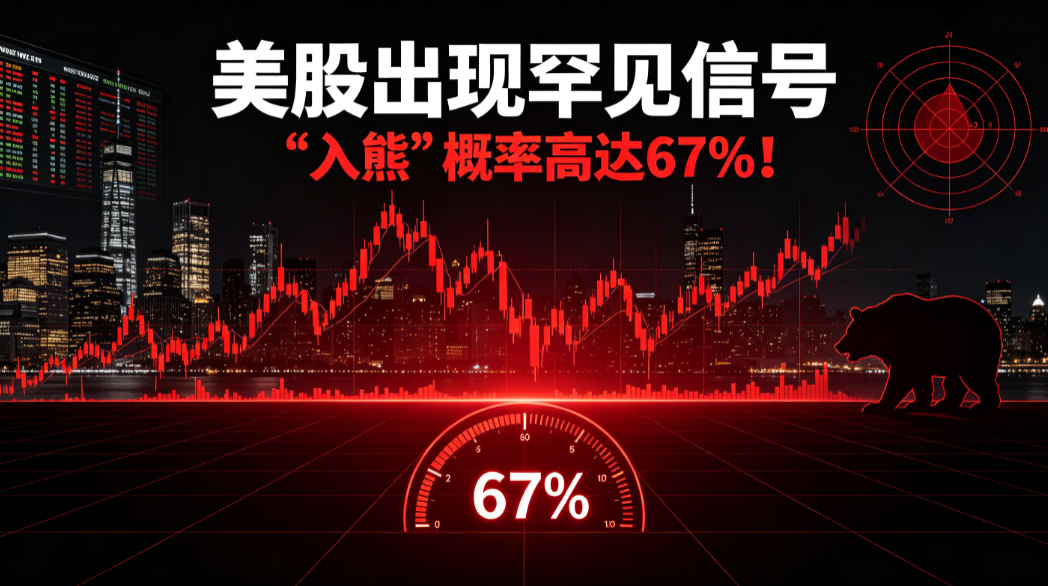
One of the most striking signals now comes from a rare divergence between the Dow Jones Industrial Average and the Nasdaq Composite. According to market analysis, when the two indexes move in opposite directions as sharply as they have recently, the probability that U.S. stocks will enter a bear market within three months rises dramatically. In fact, historical data suggest that the likelihood may be as high as 66.9%—a figure that demands serious attention from investors.
A Meaningful Split Between Old Economy and New Economy Stocks
The recent performance gap between the Dow and the Nasdaq is not a trivial market fluctuation. Over a seven-trading-day stretch ending June 25, the Dow rose 0.5%, while the Nasdaq fell 5.0%. That 5.5 percentage-point spread is substantial by any historical standard. Since the Nasdaq Composite was created in 1971, only about 1% of trading days have seen a larger seven-day gap between the two indexes.
This matters because the Dow and Nasdaq represent very different corners of the market. The Dow is dominated by mature blue-chip companies across industries such as healthcare, finance, and industrials. The Nasdaq, by contrast, is heavily weighted toward technology and growth-oriented companies. When the Dow holds up while the Nasdaq weakens sharply, it often suggests that investors are moving away from speculative or high-valuation names and toward more defensive, established businesses.
In isolation, that rotation might be interpreted as healthy. Markets frequently shift leadership among sectors, and such rebalancing can reflect changing fundamentals or risk preferences. But the current divergence is unusually large. That is what makes it potentially meaningful as a market-timing indicator.
Historical Precedent: Echoes of the Dot-Com Peak
The most obvious historical comparison is the dot-com bubble of 2000. In the final stages before the Nasdaq reached its March 2000 peak, the market exhibited a similar pattern of strain and fragmentation. In the ten trading days before that top, seven days showed a price gap between the Dow and the Nasdaq comparable to, or even larger than, the one seen recently.
What followed was not a mild correction but a devastating bear market. After peaking in 2000, the Nasdaq Composite eventually lost nearly 80% of its value. Of course, history never repeats in exactly the same way. Still, market behavior at major turning points often shares common characteristics: narrowing leadership, excessive concentration in a few names, and a growing disconnect between price and underlying fundamentals.
Today’s environment shares several of those traits. The rally in U.S. equities has been driven disproportionately by a small group of megacap technology companies, many of which are seen as direct beneficiaries of the AI boom. That concentration makes the market vulnerable. When a narrow set of stocks carries the indices, any loss of momentum in those leaders can have an outsized impact on broader sentiment.
Why This Signal Matters More Than a Simple Rotation Story
Some analysts argue that the Nasdaq’s recent weakness is merely a healthy correction within an otherwise intact bull market. According to this view, investors are simply rotating out of expensive growth stocks and into cheaper, more defensive names. In normal conditions, that interpretation would be plausible.
However, the scale of the current divergence weakens that argument. As MarketWatch columnist Mark Hulbert notes, a small gap between the Dow and the Nasdaq would be easy to dismiss. Minor discrepancies are common and generally offer little in the way of market-timing insight. But the present gap is not minor. It is statistically unusual, and historically such episodes have often been associated with significant market stress.
Hulbert’s analysis shows that since 1971, whenever the Dow and Nasdaq have diverged by an amount comparable to the current move, the U.S. stock market has entered a bear market within three months about 66.9% of the time. That is far above the baseline bear-market probability of 24.8% over the same historical period.
This does not mean a bear market is guaranteed. No indicator should be treated as a certainty. But it does suggest that investors should not dismiss the signal as noise, especially when it appears alongside other warning signs such as rich valuations, speculative enthusiasm in AI-related stocks, and increasingly concentrated market leadership.
The Role of AI Enthusiasm and High Valuations
Artificial intelligence has become the defining investment theme of the current cycle. From chipmakers to cloud infrastructure providers and software platforms, AI has inspired enormous capital flows and lofty expectations. In some cases, those expectations are justified: AI is likely to transform productivity, enterprise software, and data infrastructure over the long term.
The problem arises when investors begin pricing in perfection. If market valuations already assume years of exceptional growth, even strong earnings can disappoint. This is one reason why concerns about an AI bubble have intensified. When a thematic narrative becomes powerful enough to dominate market psychology, prices can detach from fundamentals more easily than many investors realize.
That dynamic can help explain why the Nasdaq has become more vulnerable than the Dow. The Nasdaq is more exposed to high-duration growth assets, which are especially sensitive to changes in interest rates, earnings expectations, and investor risk appetite. If enthusiasm for AI starts to cool, or if companies fail to deliver the profitability that investors expect, the resulting repricing could be severe.
What Investors Should Watch Next
The key question is not whether the market has already entered a bear phase, but whether the conditions for one are building. Several indicators deserve close monitoring.
First, market breadth should be watched carefully. A healthy bull market typically involves broad participation across sectors and market capitalizations. When only a handful of companies are driving the major averages, the market becomes more fragile.
Second, investors should pay attention to whether defensive sectors continue to outperform growth stocks. If money keeps moving toward blue chips, utilities, healthcare, and value-oriented names, that may signal growing caution beneath the surface.
Third, earnings revisions will be critical. If companies tied to the AI theme begin to disappoint on revenue growth, margins, or capital expenditure efficiency, the market may quickly reassess the sustainability of current valuations.
Finally, sentiment itself can become a warning indicator. Excessive confidence often persists until just before a correction. When investors start to believe that every pullback is an opportunity and that structural risks no longer matter, the market may already be vulnerable.
Conclusion
The current divergence between the Dow Jones Industrial Average and the Nasdaq Composite is more than a passing curiosity. It reflects a deeper shift in investor behavior and may be signaling that the market’s foundation is weakening. While no single indicator can predict a bear market with certainty, history suggests that sharp and sustained splits between blue-chip and technology-heavy indexes often appear near major turning points.
For now, the message is one of caution rather than panic. The U.S. stock market may still extend its gains, and the AI story may continue to support earnings and sentiment. But investors would be wise to recognize that a healthy market should be broad, balanced, and supported by fundamentals—not driven by a narrow group of expensive leaders.
If history is any guide, when the Dow is outperforming the Nasdaq by such a wide margin, the market is telling us that something important may be changing. Ignoring that message could prove costly.